Stock, semi-custom and custom: what the words actually mean
Stock cabinets are built in advance in fixed sizes, usually in 3-inch width increments, and warehoused ready to ship. Door styles and finishes are narrower, and filler strips make up the gaps where fixed sizes meet your walls — but a good stock line is genuinely solid, and a simple galley or L-shaped kitchen may never miss the extra flexibility. Semi-custom cabinets are built to order from a much wider size catalogue: heights, depths and widths adjust in small increments, drawer and pull-out options multiply, and finishes are applied after you order. That is why semi-custom lead times run longer — and why the cabinets arrive fitted to your room instead of padded out with fillers. Full custom means a shop builds each cabinet to the drawing: inset doors, integrated panels, an island built like furniture, finishes matched to a historic Bethesda colonial or a Rockville rambler. Custom is not automatically better built — it is more exactly built. Pay for it when the room demands exactness, not as a status tier.
Box construction: the part you cannot see in the showroom
Showrooms display doors; kitchens live on boxes. Ask three questions of any line. First, what is the box made of? Plywood sides resist the moisture cycles of a Maryland kitchen — steam, mopping, a slow dishwasher leak — better than particleboard, which swells when wet and does not forgive. Second, how are the drawers built? Well-joined drawer boxes on full-extension, soft-close slides are the difference between a kitchen that feels solid in year ten and one that feels tired in year three; a drawer full of cast iron is a real load test. Third, how is the finish applied? A factory finish, cured under controlled conditions, outlasts site-applied paint on cabinets that get wiped, bumped and steamed daily. None of this shows in a photograph, and all of it shows in a decade. If your existing boxes might deserve to stay, our guide to cabinet refacing vs replacement walks through that decision honestly — refacing a sound box is smart money; refacing a swollen, racked box is money spent twice.
Storage that actually matters: drawers, corners and the pantry question
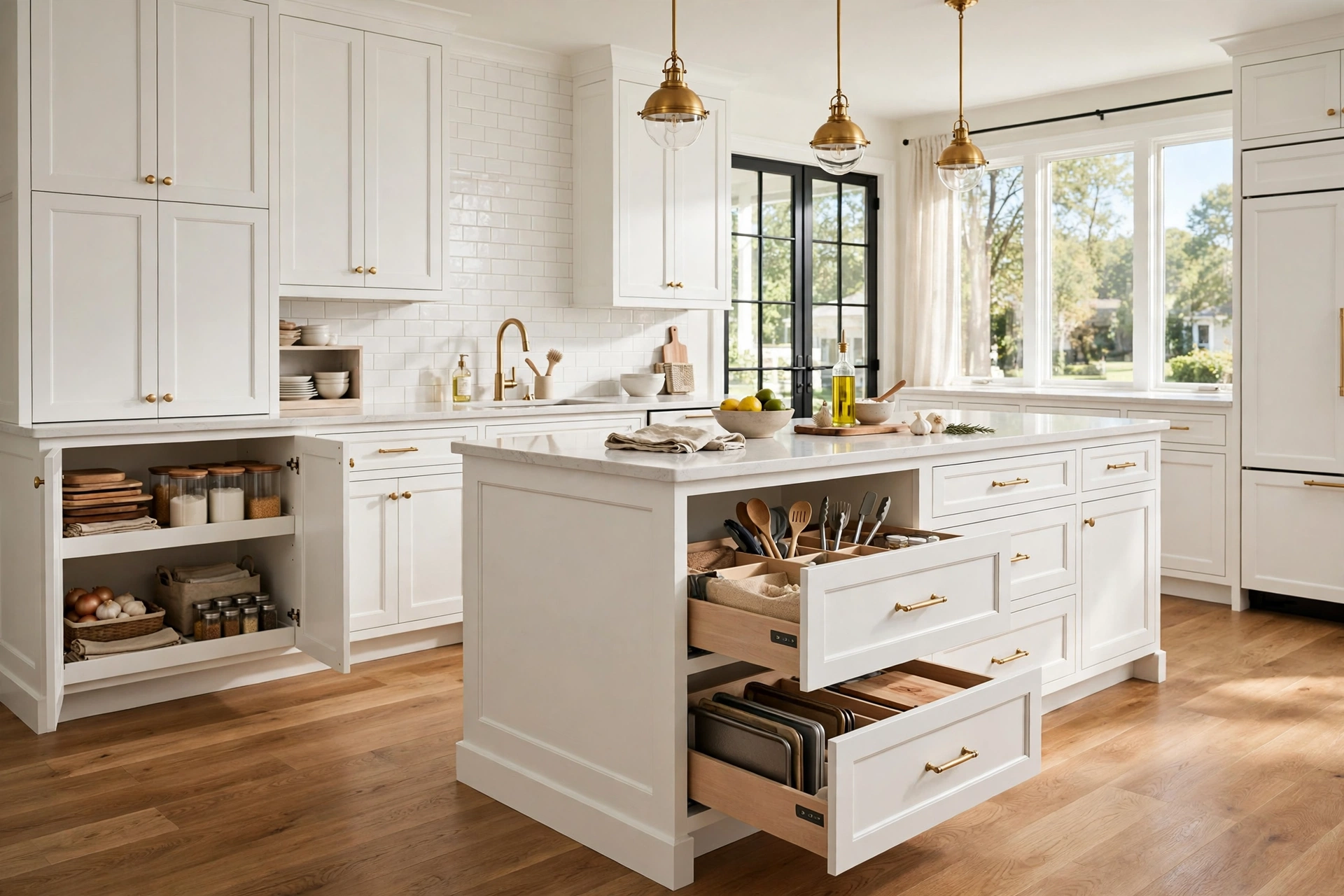
The most useful change in modern kitchen design is embarrassingly simple: drawers instead of doors in base cabinets. A deep drawer brings the pots to you; a door cabinet sends you to your knees hunting the back. Plan a bank of deep drawers near the range for cookware, a wide drawer for utensils where prep happens, and tray dividers standing baking sheets on edge instead of in a leaning stack. Corners need a decision, not a hope: a lazy Susan, a swing-out shelf system, or — in a small kitchen — a deliberately dead corner that buys cleaner runs on both sides can all be right, but an unplanned corner becomes a cave where the waffle maker goes to be forgotten.
- The pantry decision. A tall pantry cabinet with roll-out trays suits most kitchens and keeps the cabinet run unbroken. A walk-in or butler's pantry earns its footprint only when the layout gives it back in counter space or appliance storage — decide it on the plan, not in the showroom.
- Trash and recycling. A double-bin pull-out near the sink is the least glamorous and most appreciated cabinet in the kitchen. Plan it before the layout is fixed; it needs a full cabinet bay.
- Appliance storage. An appliance garage or a deep drawer sized for the stand mixer keeps counters clear. Measure your actual appliances — air fryers are not small.
- Spices near the range. A narrow pull-out beside the cooktop or a drawer insert under it ends the spice avalanche.
Door style, finish and hardware: choosing for Maryland light and life
Shaker-style doors remain the Maryland default for a reason: they sit comfortably in colonials, capes and newer builds alike, and their flat center panel wipes clean faster than ornate profiles. Slab doors read modern, but show every fingerprint on dark finishes. Painted cabinets give you the exact white, sage or navy the design calls for, with the understanding that paint on wood shows hairline movement at joints over the years — normal, and touch-up-able. Stained wood hides daily wear more gracefully. Hardware is jewelry and handle at once: choose pulls you can grip with wet hands — knobs alone on heavy drawers are a daily annoyance — and order one extra of every pull against the day a finish is discontinued. Bring samples home before deciding: north-facing Maryland light turns some whites blue and some grays green, and the showroom cannot tell you that.
How cabinet choices move the budget inside a $38,000–$115,000 kitchen
Within our published kitchen range, cabinets and their installation are usually the largest single line item, which makes the tier decision the budget decision. Our kitchen remodel cost breakdown shows how the rest of the money divides among counters, appliances, labor and finishes. The honest levers are: how many cabinets the layout truly needs (an island of drawers can replace a wall of uppers), how many specialty pull-outs and organizers you specify, whether uppers run to the ceiling — which adds a row of smaller cabinets but kills the dust shelf and finishes the room — and how much glass, paneling and integrated appliance frontage the design includes. A pattern we use often is to spend the cabinet budget where hands go daily — drawer slides, the trash pull-out, the pantry trays — and keep rarely opened uppers simpler. Our pricing guide publishes the same ranges by project type, so you can sanity-check any quote against them, including ours.
The order cabinets force on the whole project
Cabinets are the long-lead item that quietly runs the kitchen schedule. They are ordered after design and measurements are final — in an older Maryland home, measured twice, because walls that look straight rarely are — and construction bends around their delivery: demolition, rough trades, inspections, drywall and flooring must land so cabinets can be installed, leveled and templated for counters the moment they arrive. Choosing cabinets late, or changing door style after the order, restarts that clock and idles every trade behind it. That is why our design-build sequence locks the cabinet line, style, finish and storage plan before demolition begins. When cabinets are part of a larger whole-home renovation, the same order-first discipline lets the kitchen phase mesh with the rooms around it instead of stalling them.
Planning a kitchen and want the cabinet decision made once, correctly — tier, construction, storage and finish together? Call Eagle Home Improvements at (240) 266-8317 for a free in-home estimate, or use the lead form on this page with your preferred date and time. We will measure your kitchen, open your current cabinets and talk honestly about what they are telling us, then leave a fixed-price quote within 48 hours — MHIC #117311, with a 5-year workmanship warranty in writing.
Frequently asked questions
Are semi-custom cabinets worth it over stock?
For most Maryland kitchens, yes. Semi-custom sizing reduces filler strips, fits older out-of-square rooms far better, and opens up the drawer and pull-out options that decide how the kitchen works daily — without the full price and lead time of custom work.
How long do kitchen cabinets take to arrive?
Stock lines ship fastest because they are warehoused. Semi-custom cabinets are built to order and take several weeks, and full custom takes longer still. We order cabinets before demolition begins so construction never waits on the delivery.
Should upper cabinets go all the way to the ceiling?
Usually, yes, when ceiling height allows. It adds a row of smaller cabinets for rarely used items, removes the dust-collecting soffit gap, and makes the room feel finished. In very tall or historic kitchens, a deliberate crown detail can be the better answer.
Can new doors fix cabinets I hate?
Only if the boxes are sound — square, dry and solid — and the layout already works. That is a refacing conversation. If the layout fights you or the boxes are swollen or racked, replacement during the remodel is the honest fix, and we will tell you which case yours is at the estimate.