Start with moisture and structure — the office inherits whatever the basement already is
A desk, a monitor and a rack of dumbbells are the worst things to store in a damp room: electronics corrode, upholstery mildews, and rubber gym flooring traps moisture against the slab where nobody sees it spreading. That is why every office-and-gym build starts the same way our basement waterproofing guide starts — with a moisture test, a look at the gutters and grading outside, and a plan for the water the slab and walls already carry before a single stud goes up. In the colonials of Ellicott City and the split-levels of Columbia, the honest sequence is drainage and dehumidification first, insulation and framing second, and finishes last. Structure matters just as much: the gym needs a ceiling height check before equipment is ordered — a treadmill under a low soffit or a duct run is a treadmill nobody uses — and any wall that moves to open up the space gets the same load-bearing review as any other remodel. Ceiling height, duct locations and the mechanical room's footprint decide the floor plan more than any catalog photo does.
Egress, permits and the bedroom question
An office and a gym are not bedrooms, and that distinction is what keeps this project simpler than a guest suite: in most Maryland counties a finished basement used as an office or exercise room still needs building and electrical permits for the finishing work itself, but the emergency-egress window requirement is triggered by a sleeping room, not by a desk. The moment the plan includes a Murphy bed, a guest corner or any regular sleeping use, the room is a bedroom in the code's eyes and needs a code-sized egress window and well — the full picture is in our guide to basement egress windows in Maryland. Even where egress is not required, we recommend the office sit at the basement's best window: daylight is the difference between an office people choose and one they endure, and a window well with a proper cover keeps that light coming without turning the well into a leaf trap. Permits are pulled by the licensed contractor and the electrical and framing inspections happen before the walls close — the same sequence, county by county, as any other finished basement in Maryland.
Zoning the floor: office quiet, gym energy, no shared compromises
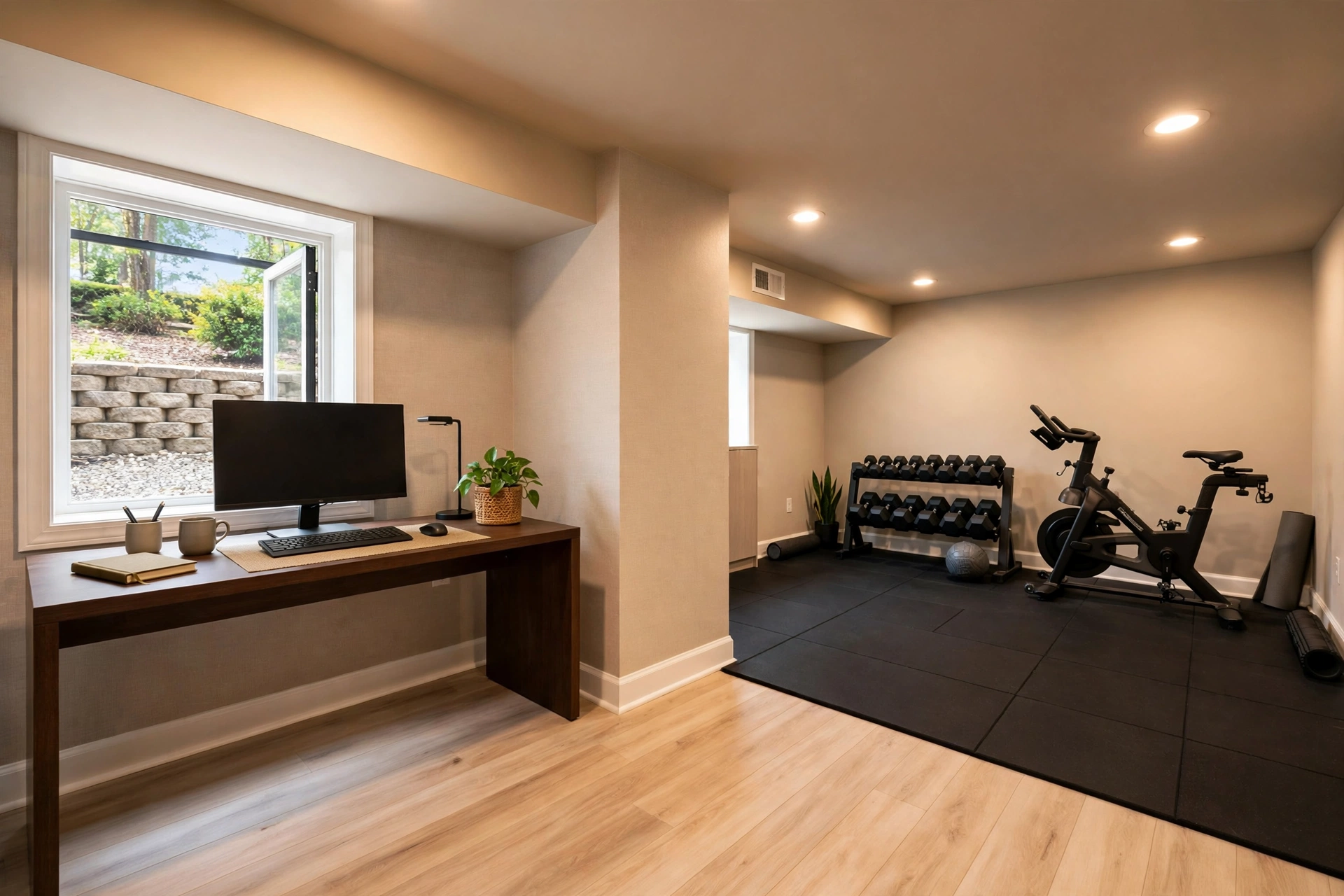
The layout that works puts the two rooms at opposite ends of the finished space with storage, a bath or the mechanical room as the buffer between them. The office takes the window wall and the door that closes — a real door, ideally solid-core, is the cheapest soundproofing in the project — with the desk placed so the window is to the side of the screen, not behind it (glare on calls) and not behind the chair (a washed-out silhouette on every video meeting). The gym takes the longest open wall and the highest ceiling, with equipment laid out so a full stride on the treadmill and a full swing of a kettlebell never reach a wall, a window or the office door. Between them, the shared zone is where a half bath, a kitchenette or simple storage earns its keep. Flooring makes the zones legible: one continuous waterproof surface through the office and circulation areas, with thick rubber mats or a dedicated rubber zone only under the equipment — the room-by-room logic is the same as our guide to choosing flooring for Maryland homes, with the gym's impact and moisture loads added on top.
Sound, air and light: the three systems that decide whether you actually use it
Most basement offices fail on one of three invisible things. Sound: footsteps and a dropped dumbbell travel through an uninsulated ceiling as if it were a drum — insulation in the joists, resilient detailing around the gym and a solid office door cut most of it. Air: a workout raises humidity fast, so both zones need real supply and return air, a dehumidifier on a drain (not a bucket someone must empty), and an exhaust fan on a timer in the gym. Light: recessed lights on dimmers for the office, brighter task light over the gym, all planned before the ceiling closes. Add the electrical honestly: dedicated circuits for the treadmill and the office equipment, outlets at desk height, and a hardwired data run if the Wi-Fi has to fight a slab and a floor of joists to reach the basement — most do.
What it costs and how long it takes
An office-and-gym zone is priced as part of the finished basement around it, inside the published $45,000–$110,000 basement range on our pricing page — where a home lands depends on how much of the level is finished, whether a bathroom is added, and how much moisture and electrical work comes first. The office costs are modest once the room exists: sound insulation, the solid-core door, data and dedicated circuits. The gym costs are the rubber flooring zone, any ceiling-height or duct work, and the ventilation. On timing the zone adds little — the critical path is still permits, framing, inspections, moisture work, then finishes — but order equipment against measured ceiling heights, door widths and the move-in route, not the plan's optimism: more than one Maryland treadmill has met a bulkhead it could not clear.
Office-and-gym mistakes we are most often hired to fix
- Finishing over a damp slab: rubber gym mats over moisture are a mold incubator. The basement is tested and dried first — finishes come after the water plan, never before it.
- The office in the windowless corner: the darkest corner becomes the storage nook, not the room someone sits in for eight hours. The office gets the window; the gym can live happily on artificial light.
- No door, or a hollow one: an open office nook hears every workout and every load of laundry. A solid-core door with seals is what makes two rooms out of one level.
- Equipment ordered before the ceiling was measured: soffits, ducts and low joist bays set the real height. Treadmills, racks and overhead lifts are chosen against the measured space.
- One circuit for everything: a treadmill, a space heater and a desk of electronics on a single older circuit is a breaker that trips mid-call. Dedicated circuits are planned at rough-in.
A basement office and gym is the rare remodel that pays you back every single weekday — a commute of fourteen steps and a workout with no drive across town. Planning one in Maryland? Call Eagle Home Improvements at (240) 266-8317 for a free in-home estimate, or use the lead form on this page with your preferred date and time. We will start with the moisture test, the ceiling height and the window — the three facts that decide the plan — and leave a fixed-price quote within 48 hours: MHIC #117311, with a 5-year workmanship warranty in writing.
Frequently asked questions
Does a basement home office need an egress window in Maryland?
Not as an office — the egress requirement is triggered by a sleeping room. If the room will be used regularly for sleeping, it counts as a bedroom and needs a code-sized egress window and well. The finishing work itself still needs building and electrical permits either way.
What flooring works for a basement office and gym?
A waterproof surface such as luxury vinyl plank through the office and circulation areas, with thick rubber mats or a dedicated rubber zone under gym equipment. Carpet in a below-grade gym traps moisture and odor, and rubber over an untested damp slab traps moisture — the slab is tested and dried first.
How do you keep gym noise out of the office and the rooms above?
Insulation in the ceiling joists, the gym zoned away from the office and the bedrooms above where the plan allows, rubber flooring under impact areas, and a solid-core door with seals on the office. No single measure does it alone — the combination is what works.
How much does a basement office and gym cost in Maryland?
It is priced as part of the finished basement around it, inside our published basement range of $45,000-$110,000. Where a home lands depends on how much of the level is finished, whether a bathroom is added, and how much moisture and electrical work the basement needs first.
Does a basement gym need special ventilation?
Yes — real supply and return air to the gym zone, a dehumidifier drained rather than bucket-emptied, and an exhaust fan on a timer. A workout raises humidity quickly, and below-grade air does not clear itself.