Why ventilation matters more in a modern, tighter house
Cooking produces far more than a smell. A gas range releases moisture, carbon dioxide, nitrogen dioxide and fine particles; searing, frying and wok cooking add grease aerosol that settles on cabinets, ceilings and the backsplash behind the range. In the older, draftier homes of Bethesda and Chevy Chase some of that escaped on its own. In a renovated kitchen — new windows, sealed drywall, better insulation — it does not. Without capture at the source, moisture condenses on cold surfaces in winter, grease shortens the life of painted cabinet finishes, and indoor air quality suffers in exactly the room the family gathers in. A correctly ducted hood removes the plume where it rises, before it spreads. That is a health and durability decision, not a luxury upgrade, and it is why ventilation belongs on the plan at the layout stage, alongside the work zones covered in our kitchen layout planning guide, not as an afterthought once the range is chosen.
How much CFM do you actually need?
CFM — cubic feet per minute — is the volume of air the hood moves. Two rules cover most homes. For a gas range, add up the BTU rating of all burners and divide by 100: a 60,000 BTU range points to about 600 CFM at full power. For an electric or induction cooktop, which produces no combustion gases, 100 CFM for every 10 inches of cooktop width is a common guide — about 300 to 400 CFM for a 30- to 36-inch top. Style changes the math: an island hood has no wall to help contain the plume, so it needs more capture — a wider canopy and higher CFM — than the same range against a wall. A hood that is too small simply misses the plume; a hood that is far oversized is not automatically better, because very large exhaust (above 400 CFM) triggers the makeup-air requirement below and can be loud enough that nobody turns it on. The best specification is a hood with several speeds: low and quiet for simmering, high for searing. If you will not run it because of the noise, its rated CFM does not matter.
Ducted vs ductless — and why we recommend ducted
A ducted hood carries air outside through metal ductwork. It removes heat, moisture, grease and combustion gases completely, and it is the only option we recommend for a gas range or a serious cook. A ductless (recirculating) hood pulls air through a grease filter and a charcoal filter and returns it to the room. It reduces some grease and odor, but it removes no heat, no moisture and no combustion gases, and the charcoal filters need regular replacement to do even that much. Ductless exists for one honest reason: no duct route. In a Rockville condo or a DC rowhouse where the range sits on an interior wall far from any exterior surface, a route may require soffits, a chase through a floor, or a run the owner does not want. Those are design problems worth solving on paper first — in most single-family Maryland homes a route exists, up through a cabinet and attic, or out through a side wall, and the modest framing and drywall work pays back every day the kitchen is used. Where a duct truly cannot run, pair a recirculating hood with an induction cooktop, which at least removes combustion gases from the equation.
Duct sizing, routing and the details that decide performance
The hood is only half the system; the duct is the other half. Undersized or rough ductwork chokes airflow and adds noise no matter what the hood is rated. The working rules: use smooth, rigid metal duct, never the flexible corrugated hose sold in big-box kits; size the duct to the hood outlet — typically 6 inches for smaller hoods, 8 to 10 inches for high-CFM models — and never step down to a smaller diameter to make a run fit. Keep the route short and straight: every elbow costs airflow roughly like several feet of straight duct, so two gentle elbows beat four sharp ones. Seal every joint with foil tape or mastic (not screws that snag grease inside), slope and terminate outside with a proper wall or roof cap fitted with a backdraft damper, and never terminate a kitchen duct in an attic, soffit vent or crawl space — that just moves the grease and moisture into the structure. Island hoods need the duct planned before the ceiling is closed, and chimney-style wall hoods need blocking in the framing. All of this is rough-in work, sequenced with the electrical and plumbing before insulation and drywall, exactly as our week-by-week kitchen remodel timeline lays out.
Makeup air: the rule Maryland homeowners hear about at inspection
When a hood exhausts more than 400 CFM, building code adopted across Maryland jurisdictions requires a makeup-air system that replaces roughly the same volume of air the hood removes. The reason is safety, not bureaucracy: a powerful hood in a tight house can create negative pressure strong enough to backdraft a gas water heater or furnace, pulling combustion gases into the home, and to make exterior doors hard to open. Makeup air can be a simple interlocked damper that opens a duct from outside when the hood runs, or a tempered system that warms incoming air in winter. It adds cost — which is one more reason not to overspecify CFM you do not need. If your design calls for a pro-style range and a 600 to 900 CFM hood, budget the makeup-air system as part of the same line item and expect the permit review — in Montgomery County through the Department of Permitting Services, and county by county elsewhere, as our Maryland permits guide explains — to ask about it. A design-build team handles this on the drawings; a hood swapped in after inspection is where the trouble starts.
Styles, mounting height and noise — choosing what you will live with
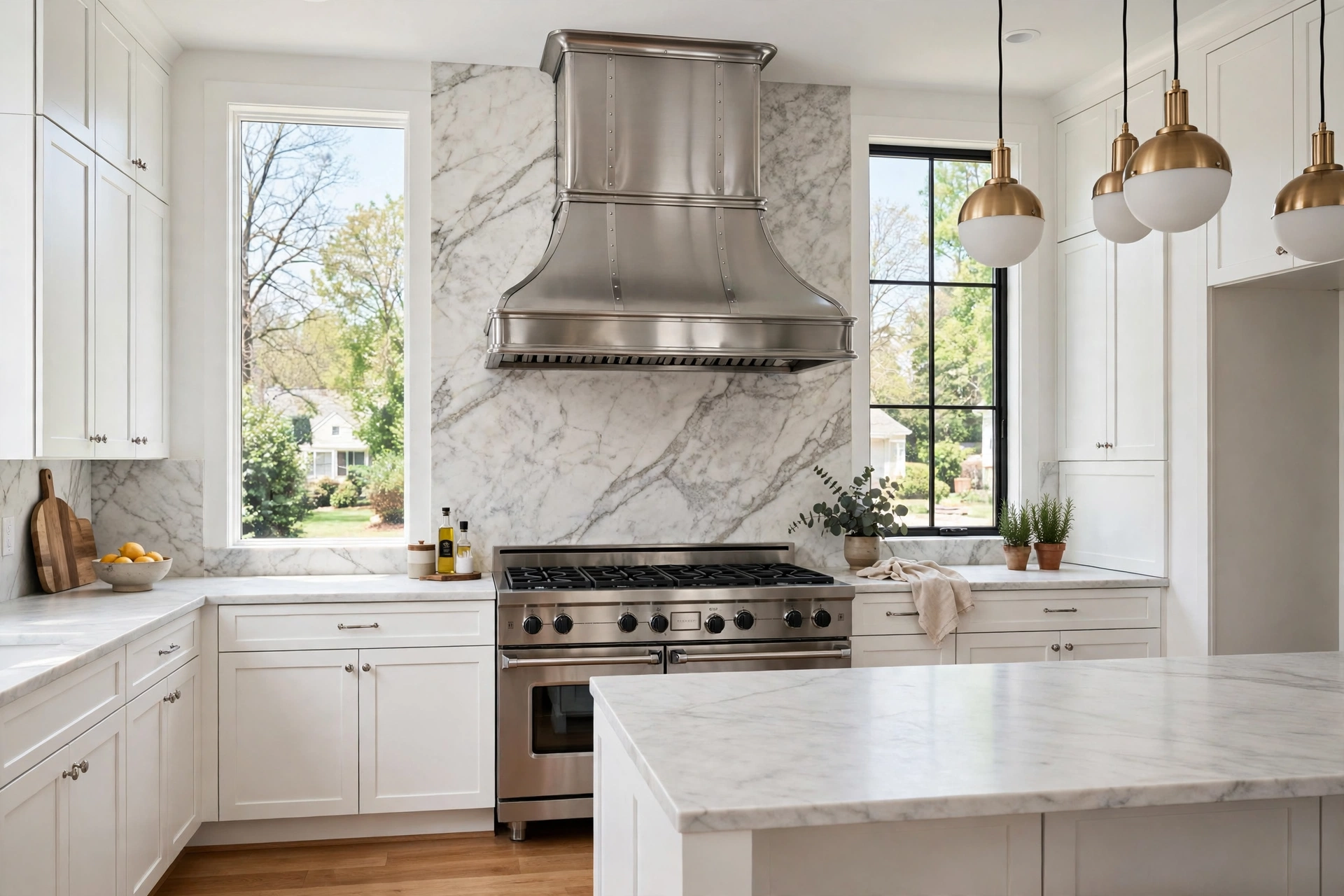
Under-cabinet, wall-chimney, island, insert (built into custom cabinetry) and downdraft are the main families. Inserts are the quiet favorite in the custom and semi-custom kitchens described in our kitchen cabinets guide: the ventilation unit hides inside a cabinet or a custom hood surround, so the kitchen design leads and the appliance disappears. Downdraft systems, which pull air down beside the cooktop, fight the natural rise of heat and steam and consistently capture the least — we recommend them only where no overhead option exists. Mounting height is set by the manufacturer, commonly 24 to 30 inches above an electric top and 30 to 36 inches above gas; mounting a hood higher for headroom or a view costs capture quickly. For noise, look at the sones rating at working speed, not just at maximum: a hood around 1 to 3 sones on its everyday speed is conversation-friendly, while many hoods only publish the flattering low-speed number. Grease filters should be dishwasher-safe baffles or mesh you will actually clean — a clogged filter cuts performance in half. Finally, plan the lighting: good hood lights are task lights for the range, and they belong in the layered plan in our kitchen lighting guide.
Ventilation mistakes we are most often hired to fix
- A ductless hood over a gas range: it filters a little grease and returns heat, moisture and combustion gases to the room. Duct outside, or change the cooktop to induction.
- Flexible duct and a stepped-down diameter: corrugated hose and a 4-inch run strangle a hood rated for an 8-inch duct — the fan is loud, the capture is weak, and grease collects in the ridges.
- Hood narrower than the range: the front burners' plume misses the canopy entirely. Match the width at minimum; go 3 to 6 inches wider per side when you can.
- No makeup air on a high-CFM hood: negative pressure, backdrafting water heaters and a failed inspection. Above 400 CFM, design the makeup air with the hood.
- Duct ending in the attic: years of grease and moisture pumped into the roof structure. Every kitchen duct terminates outside, with a damper and a cap.
A range hood is small equipment with an outsized effect on how a new kitchen feels, smells and holds up. Planning a kitchen in Maryland and choosing between hoods, duct routes or a pro-style range? Call Eagle Home Improvements at (240) 266-8317 for a free in-home estimate, or use the lead form on this page with your preferred date and time. We will trace an honest duct route in your house, size the hood and any makeup air to the range you actually cook on, and price it inside one fixed-price quote within 48 hours: MHIC #117311, with a 5-year workmanship warranty in writing.
Frequently asked questions
How many CFM does a kitchen range hood need?
For a gas range, divide the total burner BTU by 100 — a 60,000 BTU range points to about 600 CFM. For electric or induction, about 100 CFM per 10 inches of cooktop width (300-400 CFM for most) is a common guide. Island hoods need more capture than wall hoods for the same range.
Is a ductless range hood good enough?
A ductless hood filters some grease and odor but removes no heat, moisture or combustion gases, so it is not recommended over a gas range. It is a fallback where no duct route exists, ideally paired with an induction cooktop. A ducted hood that vents outside is the standard we install.
What is makeup air and when is it required?
Makeup air replaces the air a powerful hood exhausts. Where the adopted building code applies in Maryland, hoods exhausting more than 400 CFM require a makeup-air system, because negative pressure can backdraft gas water heaters and furnaces. It can be an interlocked damper or a tempered system, designed with the hood.
What size duct does a range hood need?
Match the hood outlet: typically 6 inches for smaller hoods and 8 to 10 inches for high-CFM models. Use smooth rigid metal duct, keep the run short with few elbows, seal the joints, and never reduce the diameter to make a run fit — undersized duct cuts airflow and adds noise.
How high should a range hood be mounted?
Follow the manufacturer specification, commonly 24 to 30 inches above an electric cooktop and 30 to 36 inches above gas. Mounting higher for headroom or sightlines reduces capture quickly, especially for front burners and island installations.